Construction equipment includes the machines, tools, and engineered systems used to perform excavation, earthmoving, lifting, grading, drilling, material handling, paving, demolition, and other construction activities. Heavy machinery allows large-scale projects to handle demanding physical tasks across changing site conditions.
Modern construction equipment increasingly combines mechanical systems with hydraulic technology, electronic controls, telematics, sensors, automation, and digital monitoring. Equipment selection depends on project requirements, terrain, material characteristics, operating conditions, productivity targets, safety procedures, and environmental considerations.
Context
What Is Construction Equipment?
Construction equipment refers to machinery designed for activities associated with building, civil engineering, infrastructure, mining-related construction, and site development.
Equipment can range from compact machines used in restricted areas to large heavy machinery designed for major excavation, lifting, transportation, and infrastructure projects.
Major Categories of Construction Equipment
Construction machinery can be grouped according to its primary function.
| Equipment Type | Primary Function | Common Applications |
|---|---|---|
| Excavator | Digging and material handling | Foundations, trenches, demolition |
| Bulldozer | Earthmoving and grading | Site preparation |
| Wheel Loader | Loading and material movement | Aggregates and earthworks |
| Motor Grader | Surface grading | Roads and site leveling |
| Crane | Vertical lifting | Buildings and infrastructure |
| Forklift | Material handling | Construction sites and warehouses |
| Dump Truck | Material transportation | Earthmoving and aggregates |
| Concrete Mixer | Concrete preparation | Building and infrastructure |
| Paver | Road surfacing | Highway construction |
| Drilling Rig | Ground drilling | Foundations and infrastructure |
| Compactor | Soil or asphalt compaction | Roads and foundations |
| Skid-Steer Loader | Compact material handling | Small and confined sites |
Excavators
Excavators use a boom, arm, bucket, hydraulic system, and rotating upper structure to perform digging and material-handling activities.
Different attachments can adapt an excavator for tasks such as trenching, demolition, drilling, breaking, grading, and material handling.
Bulldozers
Bulldozers use a heavy blade mounted at the front to push and distribute soil, rock, debris, and other materials. Track-based configurations provide traction across challenging terrain.
They are frequently used for site preparation, rough grading, earthmoving, and land development.
Wheel Loaders
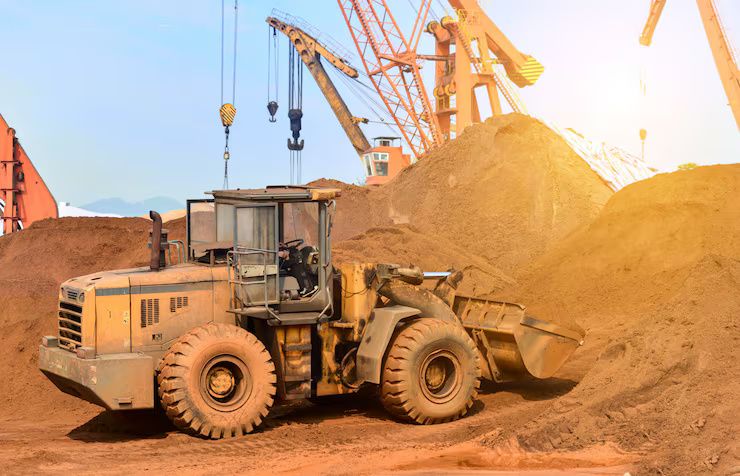
Wheel loaders use a front-mounted bucket to collect and transport loose materials. They are commonly used for handling soil, aggregates, sand, gravel, and construction debris.
Their articulated designs can provide maneuverability across material-handling areas.
Cranes
Cranes are lifting machines used to move heavy materials vertically and horizontally. Tower cranes, mobile cranes, crawler cranes, and rough-terrain cranes are among the configurations used in different projects.
Selection depends on lifting capacity, reach, site access, terrain, and project requirements.
Importance
Why Construction Equipment Matters
Construction projects frequently involve large quantities of material and demanding physical activities. Heavy machinery allows excavation, transportation, lifting, compaction, drilling, and other operations to be performed using specialized equipment.
Appropriate equipment selection can influence project scheduling, site logistics, operator requirements, fuel or energy consumption, and overall work coordination.
Supporting Earthmoving
Earthmoving equipment is used to excavate, transport, spread, and compact soil and other materials.
Excavators, bulldozers, loaders, graders, dump trucks, and compactors often operate as interconnected equipment groups during site development.
Supporting Infrastructure Development
Roads, bridges, tunnels, airports, railways, dams, and utility networks require specialized construction machinery.
Equipment can include drilling rigs, cranes, pavers, milling machines, concrete equipment, compactors, and specialized lifting systems.
Hydraulic Technology
Hydraulic systems are fundamental to many construction machines. Hydraulic pumps, valves, cylinders, motors, and reservoirs transfer fluid power to perform mechanical movements.
Hydraulic technology allows machines such as excavators, loaders, cranes, and aerial platforms to generate substantial force within compact equipment designs.
Operator Controls
Modern machines can incorporate electronic control systems, joysticks, digital displays, cameras, sensors, and automated functions.
These technologies provide operators with information about machine status and can assist with selected machine-control functions.
Construction Technologies
Machine Control Systems
Machine-control technologies use positioning information, sensors, and onboard computers to guide selected machine functions.
Applications can include grading, excavation, compaction, and site preparation. Depending on the system, positioning may use GNSS, laser references, inertial sensors, or other measurement technologies.
Telematics
Construction equipment telematics systems collect and transmit information about machine operation.
Data can include operating hours, location, fuel or energy consumption, fault information, engine conditions, and selected utilization indicators.
GPS and GNSS Technologies
Satellite positioning technologies can support equipment tracking and machine guidance. GNSS-based systems are commonly associated with grading, excavation, surveying, and fleet coordination.
Accuracy depends on the equipment configuration, correction technology, environmental conditions, and site characteristics.
Autonomous and Semi-Autonomous Equipment
Automation is being incorporated into selected construction machinery. Systems can support functions such as automated grading, controlled hauling, machine guidance, and selected repetitive operations.
Fully autonomous operation remains dependent on the equipment type, site conditions, regulatory environment, and technological maturity.
Electric Construction Equipment
Battery-electric and hybrid technologies are being developed for various construction machines. Compact excavators, loaders, forklifts, and other equipment categories can use electric powertrains in selected applications.
Electric equipment can reduce direct exhaust emissions at the operating location, although total environmental impact depends on factors such as electricity generation, battery production, equipment use, and end-of-life management.
Manufacturers and Suppliers
The construction-equipment manufacturing ecosystem includes producers of heavy machinery, compact equipment, lifting systems, material-handling equipment, road machinery, concrete equipment, drilling systems, and attachments.
Organizations evaluating manufacturers or suppliers can consider:
- Machine specifications
- Operating capacity
- Engine or powertrain configuration
- Hydraulic performance
- Attachment compatibility
- Control technologies
- Operator visibility
- Safety features
- Maintenance requirements
- Telematics capabilities
- Spare-component availability
- Technical documentation
Equipment selection should be based on actual project requirements rather than machine size alone.
Industrial Applications
Building Construction
Building projects use excavators, loaders, cranes, concrete equipment, forklifts, aerial platforms, compactors, and other machines.
Equipment selection varies according to building height, site access, material requirements, structural design, and construction stage.
Road Construction
Road projects commonly use graders, excavators, loaders, milling machines, asphalt pavers, rollers, compactors, and dump trucks.
Different machines perform excavation, base preparation, paving, leveling, and compaction activities.
Mining and Quarrying
Heavy machinery is used for excavation, loading, hauling, crushing, drilling, and material handling.
Large excavators, haul trucks, drilling systems, loaders, and support equipment can operate together within mining and quarry environments.
Bridge and Infrastructure Projects
Bridge construction can require cranes, piling equipment, concrete systems, drilling rigs, lifting platforms, and specialized transport equipment.
The machinery is selected according to structural components, lifting requirements, site conditions, and access limitations.
Demolition
Demolition equipment can include excavators equipped with hydraulic breakers, shears, grapples, pulverizers, and other attachments.
Dust management, structural assessment, exclusion zones, and machine stability are important considerations.
Utility Construction
Water, sewer, electrical, telecommunications, and gas infrastructure projects frequently use compact excavators, trenchers, loaders, drilling equipment, cranes, and material-handling machinery.
Equipment size may be selected according to excavation depth, working-space limitations, and underground infrastructure requirements.
Recent Updates
Connected Construction Equipment
Connected machinery can transmit operational information to fleet-management platforms. This can improve visibility into equipment location, operating hours, fault conditions, and utilization.
Connectivity also creates opportunities for centralized fleet analysis across multiple project sites.
Advanced Telematics
Telematics platforms increasingly combine machine data with maintenance information, location data, and utilization analysis.
This can help fleet managers identify underused equipment, track operating patterns, and schedule inspections according to defined maintenance programs.
Machine Vision
Cameras and machine-vision technologies are being integrated into construction equipment to improve operator awareness and support automated functions.
Applications can include object detection, site monitoring, machine guidance, and selected safety-related alerts.
Digital Construction Workflows
Construction projects increasingly use Building Information Modeling (BIM), digital surveying, project-management platforms, and connected equipment.
Machine data can complement digital site information and help coordinate equipment with broader construction workflows.
Electrification
Electrification is expanding across selected equipment categories. Compact machines and equipment operating in urban or enclosed environments are areas where electric powertrains can provide particular operational advantages.
Charging infrastructure, battery capacity, duty cycles, ambient temperature, and site power availability remain important considerations.
Alternative Fuels
Construction machinery manufacturers and researchers are also evaluating alternative power technologies, including hydrogen-based systems, renewable fuels, hybrid architectures, and advanced internal-combustion technologies.
The suitability of each approach depends on machine size, duty cycle, infrastructure, and regulatory requirements.
Laws or Policies
Construction Safety
Construction equipment must be operated according to applicable workplace-safety requirements. Regulations can address machine guarding, operator training, lifting operations, inspections, site traffic, equipment maintenance, and personal protective equipment.
Requirements differ between jurisdictions and equipment categories.
Lifting Equipment
Cranes, hoists, forklifts, and other lifting equipment may be subject to specific inspection, load-rating, operator-qualification, and maintenance requirements.
Load charts and manufacturer operating instructions should be followed for the relevant equipment configuration.
Environmental Requirements
Construction projects may need to manage equipment emissions, noise, dust, fuel storage, hydraulic-fluid leakage, waste, and other environmental impacts.
Local regulations determine the applicable requirements.
Operator Training
Operators of heavy machinery may require equipment-specific training or certification depending on the jurisdiction and equipment type.
Training can include machine controls, hazard recognition, inspection procedures, emergency response, and safe operating practices.
Equipment Inspection
Pre-use inspections and periodic maintenance can help identify mechanical, hydraulic, electrical, or structural issues.
Inspection schedules should follow manufacturer requirements, organizational procedures, and applicable regulations.
Tools and Resources
Fleet Management Platforms
Fleet-management software can collect information from connected construction machines. Typical functions include equipment location, utilization monitoring, maintenance records, and operating-hour tracking.
Machine Control Software
Machine-control platforms can integrate positioning information with machine hydraulics and onboard displays.
These systems can support defined grading and excavation tasks where the appropriate hardware and site references are available.
BIM Platforms
BIM tools provide digital representations of buildings and infrastructure. Construction teams can use BIM information to coordinate design, quantities, sequencing, and site activities.
Maintenance Management Systems
CMMS platforms can track inspections, maintenance schedules, equipment records, component changes, and operating history.
Equipment Inspection Tools
Digital inspection applications can record pre-use checks, photographs, defects, corrective actions, and inspection dates.
FAQs
What is construction equipment?
Construction equipment includes machines and tools used for excavation, earthmoving, lifting, material handling, drilling, paving, demolition, grading, concrete processing, and other construction activities.
What are the main types of heavy construction machinery?
Common categories include excavators, bulldozers, loaders, cranes, dump trucks, graders, compactors, drilling rigs, concrete equipment, pavers, and forklifts.
How is automation used in construction equipment?
Automation can support machine guidance, grading, positioning, equipment monitoring, repetitive machine functions, and selected autonomous operations.
What is construction equipment telematics?
Telematics uses connected hardware and software to collect information about equipment location, operating hours, machine condition, utilization, and selected performance indicators.
What should organizations consider when selecting construction equipment suppliers?
Important considerations include machine capacity, powertrain, hydraulic systems, attachment compatibility, safety features, maintenance requirements, telematics, technical documentation, and project-specific operating conditions.
Conclusion
Construction equipment provides the mechanical capability required for modern building, infrastructure, road, utility, mining, and site-development projects. Excavators, bulldozers, loaders, cranes, graders, compactors, drilling systems, concrete equipment, and other specialized machines perform different functions across the construction lifecycle.
The industry is increasingly incorporating telematics, machine control, GNSS positioning, automation, machine vision, digital construction workflows, and electric powertrains. As these technologies develop, equipment selection will increasingly involve both mechanical specifications and digital capabilities.