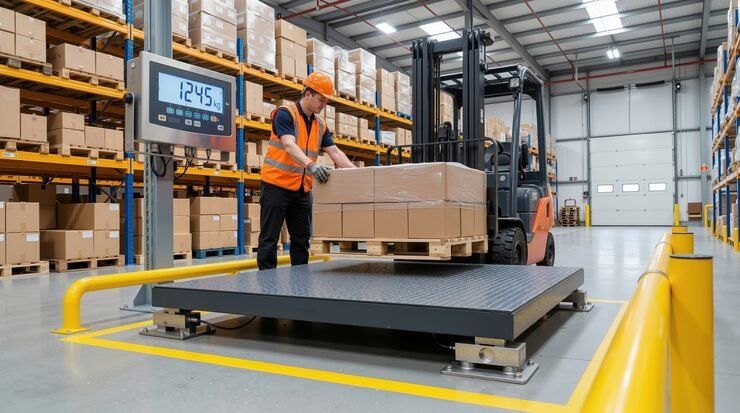
Pallet weighing scales are industrial weighing systems designed to measure the weight of palletized goods, raw materials, packaged products, containers, and other loads. They are commonly used in warehouses, manufacturing facilities, logistics operations, distribution centers, agriculture, food processing, and industrial plants.
Modern pallet weighing scales combine load cells, digital indicators, weighing platforms, data systems, and automation technologies to provide controlled and repeatable weight measurements. Selecting the appropriate scale depends on load capacity, pallet dimensions, accuracy requirements, operating environment, and application.
Why Pallet Weighing Scales Matter
Accurate weight measurement is important when materials are received, stored, processed, shipped, or transferred between production stages. Pallet scales allow operators to determine load weight without manually separating products from the pallet.
They can help organizations:
Verify incoming and outgoing loads
Monitor material quantities
Support inventory management
Check production weights
Prepare shipping documentation
Identify weight variations
Integrate weighing into warehouse workflows
For industrial environments, the scale should be selected according to the expected load range and operating conditions rather than capacity alone.
Types of Pallet Weighing Scales
Different scale configurations are designed for different warehouse and industrial requirements.
Floor Pallet Scales
Floor scales are installed at ground level and provide a platform onto which pallets can be placed using pallet trucks, forklifts, or other handling equipment.
They are widely used for general warehouse and manufacturing applications.
U-Shaped Pallet Scales
U-shaped scales are designed to allow pallet trucks to enter the weighing structure directly. This configuration can make pallet weighing convenient in areas where dedicated loading equipment is not available.
Low-Profile Pallet Scales
Low-profile designs minimize the height between the floor and weighing platform. They can simplify pallet loading and may reduce the need for ramps.
Portable Pallet Scales
Portable systems can be relocated between work areas. They are useful when weighing points change or when a facility needs flexibility in its material-handling operations.
Forklift Weighing Systems
Forklift scales incorporate weighing technology into forklift equipment, allowing loads to be weighed during handling. These systems can reduce the need to move pallets to a separate weighing station.
Pallet Scales With Indicators
These systems combine a weighing platform with a digital indicator that displays the measured weight. Advanced indicators may also support data transmission, printing, counting, and integration with software systems.
Pallet Weighing Technologies
The weighing mechanism is a key component of an industrial pallet scale.
Load Cell Technology
Load cells convert mechanical force into an electrical signal that can be interpreted by the weighing indicator.
Depending on the scale design, multiple load cells may be positioned beneath the platform to distribute and measure the load.
Digital Weighing Systems
Digital indicators process signals from the load cells and display the measured weight. Modern systems can provide features such as tare functions, unit conversion, overload detection, and data storage.
Wireless Weighing
Wireless systems can transmit measurement data to computers, warehouse systems, or other connected devices. This can reduce cabling requirements and support mobile workflows.
Integrated Data Systems
Advanced industrial scales can connect with warehouse management, enterprise resource planning, inventory, production, or shipping systems. This enables weight information to become part of a broader digital workflow.
Pallet Scale Accuracy
Accuracy requirements depend on the application.
A warehouse weighing system used for general material tracking may have different accuracy requirements from a scale used for regulated commercial transactions or precise production processes.
Factors affecting weighing performance include:
Load cell quality
Scale capacity
Platform construction
Load distribution
Installation surface
Temperature
Vibration
Calibration
Environmental conditions
Operator practices
Regular calibration and appropriate installation can help maintain consistent measurement performance.
Pallet Weighing Scale Manufacturing
Manufacturing a pallet weighing scale involves several stages, from structural fabrication to sensor installation and final testing.
Platform Fabrication
The weighing platform is generally manufactured from materials selected for the expected load and operating environment. Steel is commonly used for heavy industrial applications.
Load Cell Installation
Load cells are positioned beneath the platform and connected to the weighing electronics. Their arrangement depends on the scale design and load capacity.
Electronics Integration
The load cells are connected to a junction system and digital indicator. Electronics may include signal processing, display controls, communication interfaces, and configuration functions.
Calibration and Testing
Completed scales are tested using controlled loads to verify measurement performance. Calibration procedures help establish the relationship between applied load and displayed weight.
Surface Treatment
Industrial scales may receive coatings or finishes intended to improve resistance to moisture, corrosion, chemicals, abrasion, or repeated cleaning.
How to Select a Pallet Weighing Scale
Selecting the appropriate scale involves evaluating several technical requirements.
1. Determine Load Capacity
Identify the minimum and maximum loads expected during regular operation. A suitable capacity provides sufficient operating range without unnecessarily oversizing the scale.
2. Check Pallet Dimensions
The platform should accommodate the pallet dimensions and allow the load to be positioned safely.
3. Consider Accuracy
Determine the required measurement resolution based on the application, inventory requirements, production process, and applicable regulations.
4. Evaluate the Environment
Consider whether the scale will operate indoors, outdoors, in wet environments, in washdown areas, or around chemicals and dust.
5. Review Data Connectivity
If weight information must enter a warehouse or production system, evaluate available interfaces such as Ethernet, serial communication, USB, wireless connectivity, or other integration options.
6. Consider Maintenance
Accessible load cells, replaceable components, straightforward calibration procedures, and robust construction can simplify long-term maintenance.
Pallet Weighing Scale Cost Factors
The cost of pallet weighing scales varies according to their specifications and configuration.
Important factors include:
Maximum weighing capacity
Platform size
Load cell configuration
Indicator type
Construction materials
Accuracy and resolution
Wireless connectivity
Printing capabilities
Software integration
Legal-for-trade requirements
Environmental protection
Installation requirements
A basic floor pallet scale and an automated forklift weighing system can have substantially different technical specifications and project requirements.
Industrial Applications
Pallet weighing scales are used across many industries.
| Industry | Typical Application |
|---|---|
| Warehousing | Inventory and shipment verification |
| Manufacturing | Raw material and finished-product weighing |
| Logistics | Shipment weight measurement |
| Food Processing | Ingredient and packaged-product weighing |
| Agriculture | Produce, feed, and bulk material weighing |
| Pharmaceuticals | Controlled material handling |
| Chemical Processing | Raw material and finished-product measurement |
| Recycling | Material load measurement |
| Distribution | Receiving and dispatch verification |
Best Practices for Pallet Weighing
For consistent weighing performance, operators should keep the platform clean and ensure loads are positioned correctly. The scale should be installed on a suitable surface and protected from unnecessary vibration or impact.
Calibration should follow the manufacturer's recommendations and any applicable regulatory requirements. Operators should also avoid exceeding the rated capacity because overloads can damage weighing components.
For connected systems, regular verification of communication between the scale indicator and software platform can help prevent missing or incorrect weight records.
Frequently Asked Questions
What is a pallet weighing scale?
A pallet weighing scale is an industrial weighing system designed to measure the weight of palletized loads, products, raw materials, and other heavy items.
How accurate are pallet weighing scales?
Accuracy varies by scale design, capacity, load cells, installation, calibration, and application. The required accuracy should be selected according to the intended use.
What is the difference between a pallet scale and a floor scale?
A pallet scale is specifically configured for palletized loads, while the term floor scale can describe a broader range of platform-based industrial weighing systems.
What affects pallet weighing scale cost?
Capacity, platform size, load cell technology, construction, accuracy, connectivity, environmental protection, printing, software integration, and regulatory requirements can all affect the overall cost.
Can pallet weighing scales connect to warehouse software?
Yes. Many modern systems support communication interfaces that can transmit weight data to warehouse management, inventory, production, or enterprise software.
Conclusion
Pallet weighing scales provide an important measurement function across warehouses, manufacturing facilities, logistics operations, and industrial plants. Available configurations range from floor and U-shaped pallet scales to portable systems and forklift-integrated weighing technologies.
The right selection depends on load capacity, pallet dimensions, accuracy, environmental conditions, data connectivity, and maintenance requirements. Understanding these factors allows organizations to match weighing technology with their operational needs.
For a new installation, start by defining the expected load range, weighing accuracy, pallet dimensions, operating environment, and required data integration. These requirements provide a practical foundation for comparing pallet weighing scales and their technical configurations.